
Introduction: "Can a foreigner buy property in this country?"
When people think about property abroad, the same questions often come up.
- "Can a foreigner buy land or an apartment in this country?"
- "Which taxes do I pay when I buy, while I own, and when I sell?"
- "I want to check rental yields, typical rents and price trends with official figures."
- "I want to know the country's actual rules, not online stories or ads."
With property abroad, what matters is checking the country's laws and official figures. Information in ads and roundup articles can be out of date or only tell part of the story.

6 things to check first when researching property abroad
1. Can foreigners buy? (foreign ownership restrictions)
In some countries, foreigners cannot own land, or there are limits on the type or share of property they can buy. This is the first thing to check.
2. Freehold or leasehold
Whether you can own the land outright or only lease it for a long period depends on the country. Also check how long you can hold it and the rules for renewal.
3. Taxes (when you buy, while you own, when you sell)
There are taxes when you buy, taxes you pay every year, and taxes when you sell, such as capital gains tax. Some countries also have taxes that apply only to foreign buyers.
4. Rental rules
If you rent the property out, tenancy laws that protect tenants and rules on raising rent are important. Contract length and termination rules also differ by country.
5. Rental yield and typical rents
If you see it as an investment, the rental yield (rental income as a percentage of the price) and typical rents are useful guides.
6. Price trends (house price index)
Many national statistics offices and central banks publish property price trends as an index. It shows whether prices are rising or holding steady.
Other useful clues when choosing a country include rules on sending money abroad, mortgage interest rates, building regulations, incentives in special economic zones, the number of transactions and population trends.
The hard part: finding and comparing each country's official information
- The language barrier — laws and government documents are often written only in the country's own language
- The search effort — rules, taxes and statistics are spread across different government offices
- Keeping up to date — laws and tax rates change, so it is hard to tell which rules apply today
Compare official information only, in your native language, with Factdock's Real Estate Investment
Factdock's Real Estate Investment is a tool where you just choose a country and the topics you want to check. It searches official sources only, such as governments, statistics offices, central banks and land registries, in the country's own language, and shows the results in your native language.
This tool helps you research property abroad. It is not investment or legal advice. Before you decide to buy or sign a contract, always check the original sources and talk to a local professional.
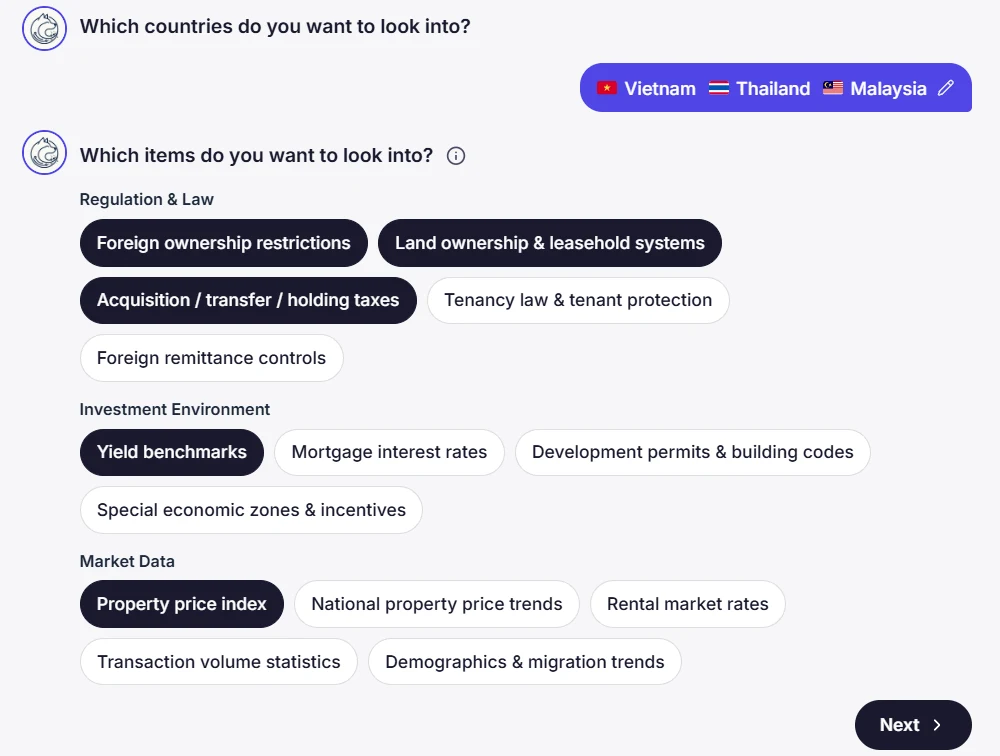
1. Choose up to 3 countries and the topics you want to check
Choose 1 to 3 countries to compare, then pick topics such as foreign ownership restrictions, taxes, rental yield and the price index. You can also narrow it down by entering a city or area.
2. Search official information only, in the country's own language
It searches official sources only, such as governments, statistics offices, central banks, land registries and international organizations. Because it searches with the official terms in the country's own language, it can reach local laws and announcements.
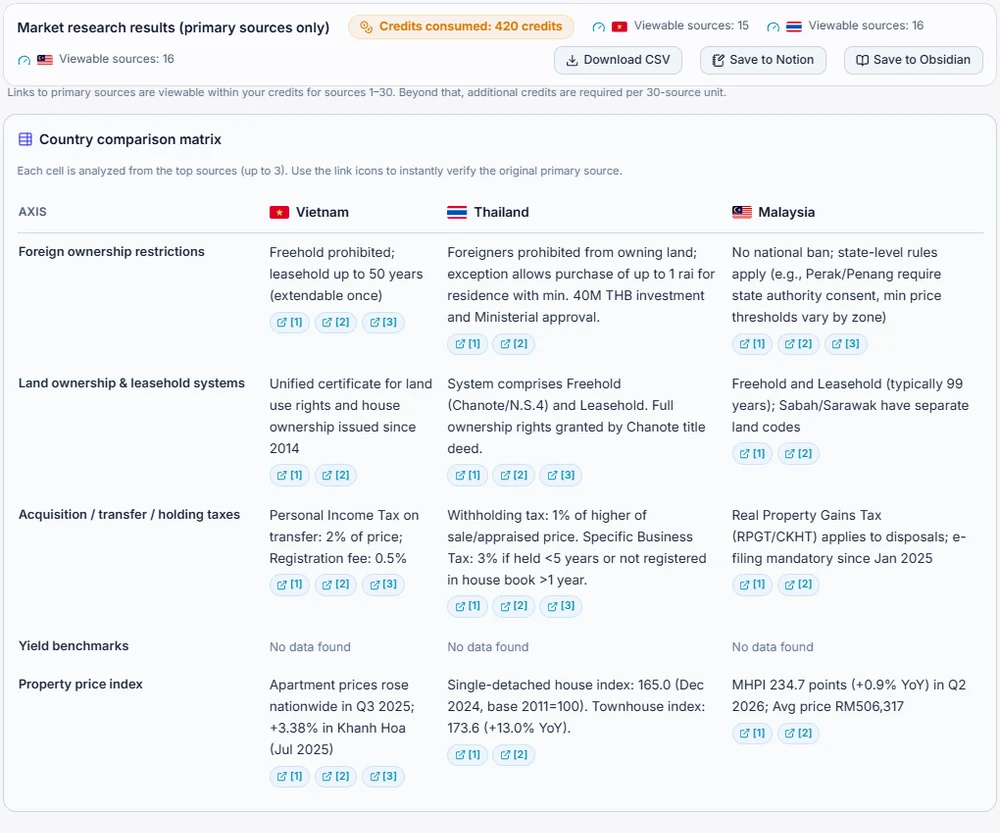
3. Compare countries side by side in a table with sources
When you choose two or more countries, the details for each topic appear in a comparison table. Every item has a source, and where no official information was found, the cell is left blank. We never fill gaps with guesses.
4. In some countries, you can also check official land registry information
Enter an address or pick a spot on the map, and in some countries you can check transaction records or the address against the country's official land registry and map information. For countries where this is not available, we show you how to check through the official office.
If you want to compare the economies of the countries themselves, you can also use the method from our article on how to compare countries' economies.
Who this is for
- People thinking about investing in property abroad — when you want to check foreign ownership rules, taxes and yields with official information
- Companies looking to rent an office or factory abroad — when you want to understand rental rules and development regulations
- People thinking about moving abroad — when you want to learn the rules for buying or renting a home in your own language
- Anyone who wants to research in their own language — both your input and the results are in your native language
Pricing
Available from $3. Feel free to give it a try. You can find full details on our pricing page.
Conclusion
Property rules are completely different in each country. That is exactly why checking the country's official information is the shortest path to peace of mind.
If you find yourself wondering, "Can a foreigner buy property in this country?", start by checking the official information in your native language.
* The content shown is reference information gathered and organized from official sources. It is not investment or legal advice. Before making important decisions, always check the original sources and talk to a local professional.
What it is
Factdock in 2 minutes 30 seconds
The video is in English. You can choose subtitles in your language from the player settings.
Frequently asked questions
Does it give investment or legal advice?
No. Factdock only finds official information and shows it together with its sources. It does not decide things like which property you should buy. Before you decide to buy or sign a contract, always talk to a local professional.
Which sources does it use?
Only official sources, such as governments, statistics offices, central banks, land registries and international organizations. It does not use property agency ads or roundup sites.
Can I check the land registry in every country?
Official land registry information can be checked only in some countries. For countries where this is not available, we show you how to check through that country's official office.
Can I use it in English?
Yes. Both your input and the results are shown in English. Besides English, you can use it the same way in 109 languages, including your native language.
How much does it cost?
It is available from $3. See our pricing page for full details.
Our own patent-pending search engine
Property abroad, checked with official information. In your own language.
Just choose a country and topics. Compare foreign ownership rules, taxes, rental yields and more from official sources, with citations, in your native language.