Introduction: the research starts after the consultation ends
If every case were a textbook case, there would be nothing to look up. But in real practice, questions like these come up all the time:
- "Has this combination of symptoms and lab values been reported anywhere abroad?"
- "This patient reacts to chicken. Is it safe to recommend this food?"
- "The current medication, plus the supplement the owner brought in. Are they fine together?"
When you start looking, most papers are in English. Food ingredient lists and case reports are in each country's own language. AI will give you an answer straight away, but where the evidence for that answer comes from is something you still end up checking yourself.
How Factdock thinks: vets make the diagnosis. We find the evidence
Factdock's veterinary tools are built on one important principle: the diagnosis is made by the vet.
Our job is to gather the material for that decision. We search papers and official data from around the world and lay everything out with its source. If no source can be found, the information is not shown.
And we do it in 109 languages. English papers and case reports from other countries can be read in the language you use every day. From here, let's follow one patient and look at the four tools in turn.
The screenshots in this article are shown in English, French, German and Chinese. Factdock works the same way in every language.
A day at the clinic: a 6-year-old dog with persistent itching
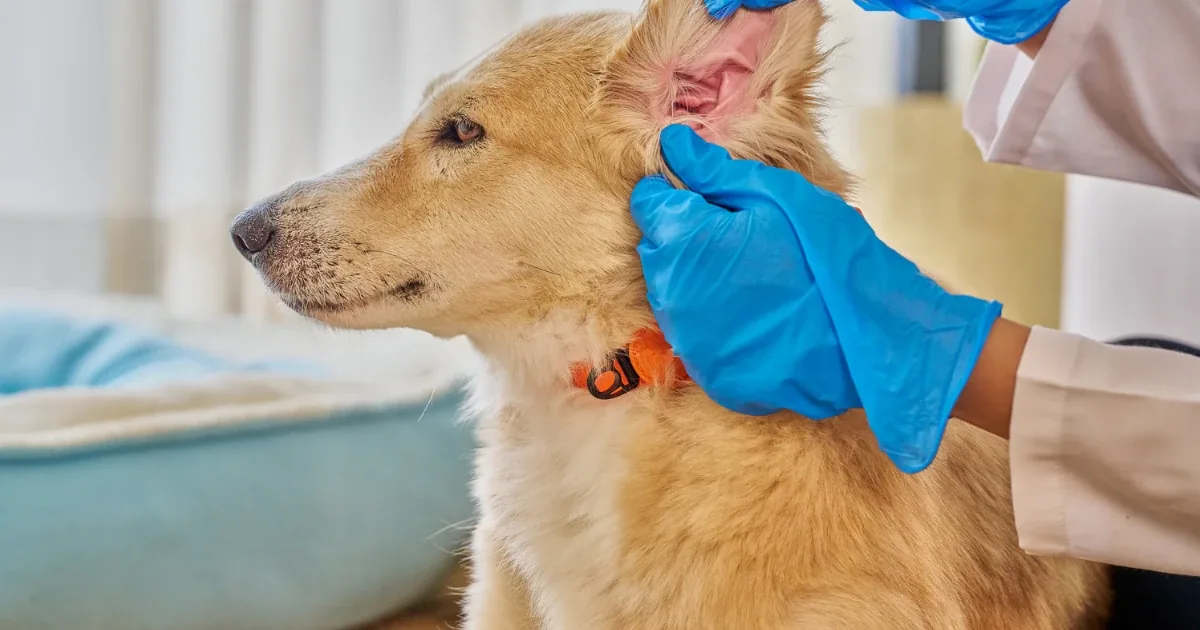
A 6-year-old dog. Itching and hair loss have continued for some time. The dog once had an allergic reaction to chicken. The owner asks: "Should we change the food?" and "Is it OK to give this supplement too?"
So, where do we start?
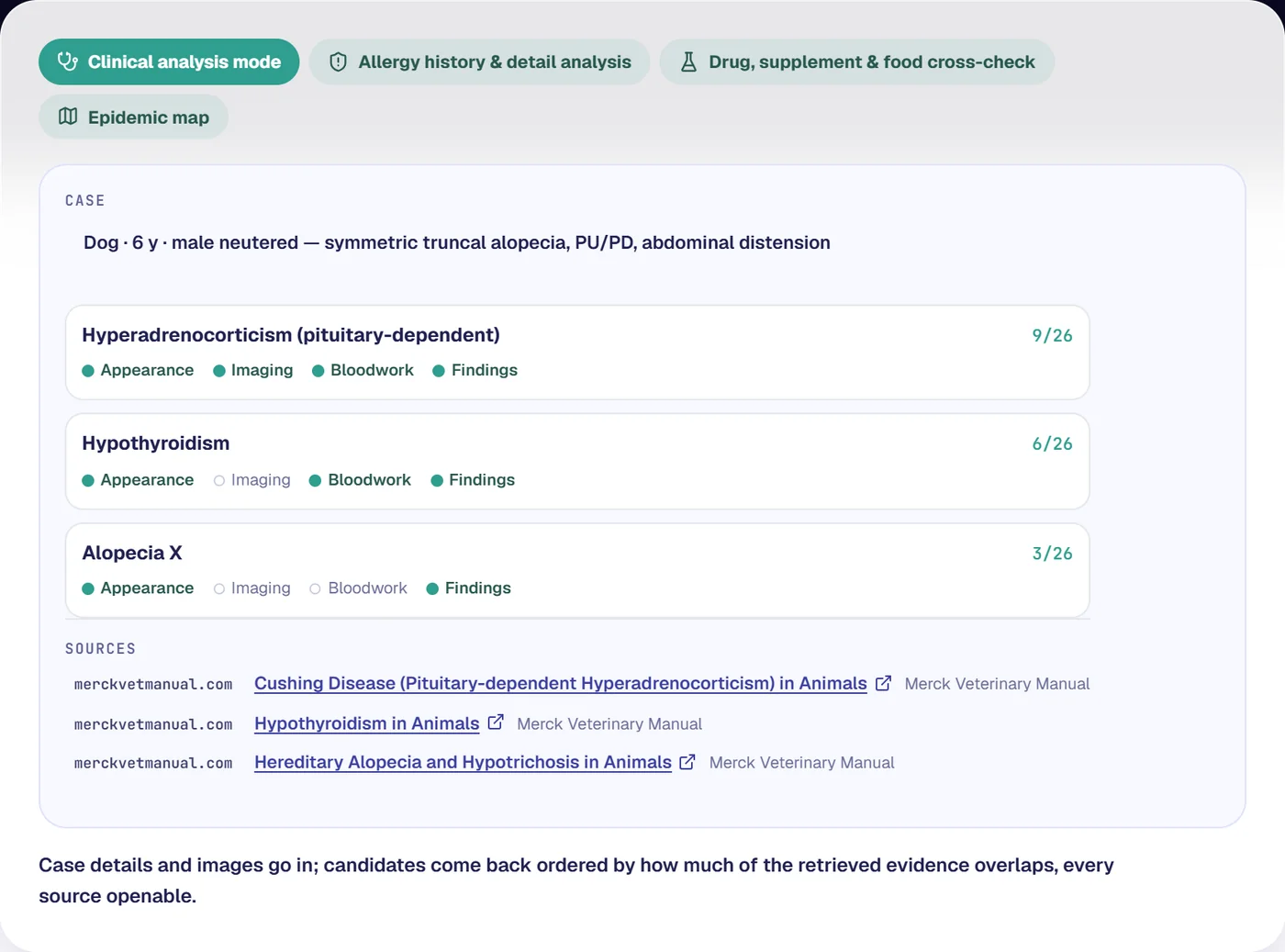
STEP 1 Clinical analysis: find case reports worldwide from symptoms and lab values
First, enter the symptoms, findings, blood test values and photos of the affected area.
Factdock does not ask AI to guess a disease name. Using only the observed facts you entered, it searches the world's academic databases channel by channel: appearance, diagnostic imaging, blood tests, findings and so on.
This is Factdock's most distinctive feature. We match up the sources found in each channel, and diseases that come up across several channels are ranked higher, as more likely candidates.
For example, if the photo of the affected skin, the blood tests and the findings all turn up reports on the same disease, that candidate ranks near the top. If it is found in only one channel, it sits further down. That is the difference from an ordinary AI search, which sums everything up into one answer.
Each candidate in the ranking shows which channels it was found in, and how many sources, and you can open the supporting papers right through to the source. Because you can see why each candidate ranks where it does, the final judgement stays with the vet.
The search is built on English-language literature, and you can add up to 4 languages such as Japanese, Korean, Chinese, German, French, Spanish and Arabic. That brings in reports from individual countries that English alone would miss.
STEP 2 Allergy history & detail analysis: is there a "hidden ingredient" in the current food?
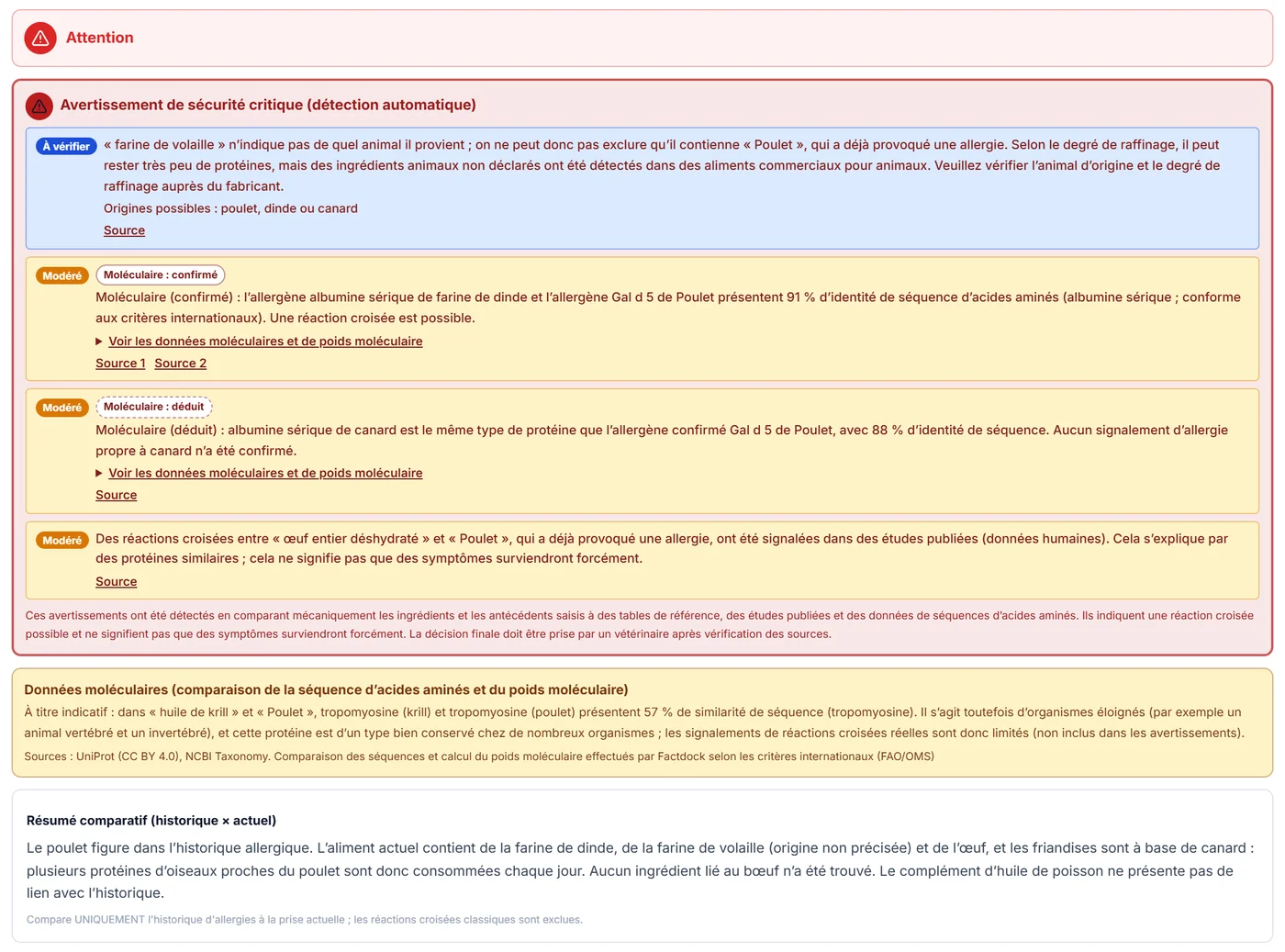
This dog has reacted to chicken before. Even if the current food contains no chicken, that does not mean it is safe. Ingredients with different names can have proteins with a similar structure and trigger the same reaction. That is cross-reactivity.
Factdock compares the allergy history with the current food, treats and supplements at the level of ingredients and proteins. Based on international protein databases and papers, it shows the strength of the evidence on 4 levels: "Confirmed", "Reported in papers", "Estimated" and "For reference".
STEP 3 Food and supplement options: "So what can the dog eat?"
Once you know which ingredients to watch out for, the next step is answering the owner's question: "What should we switch to?"
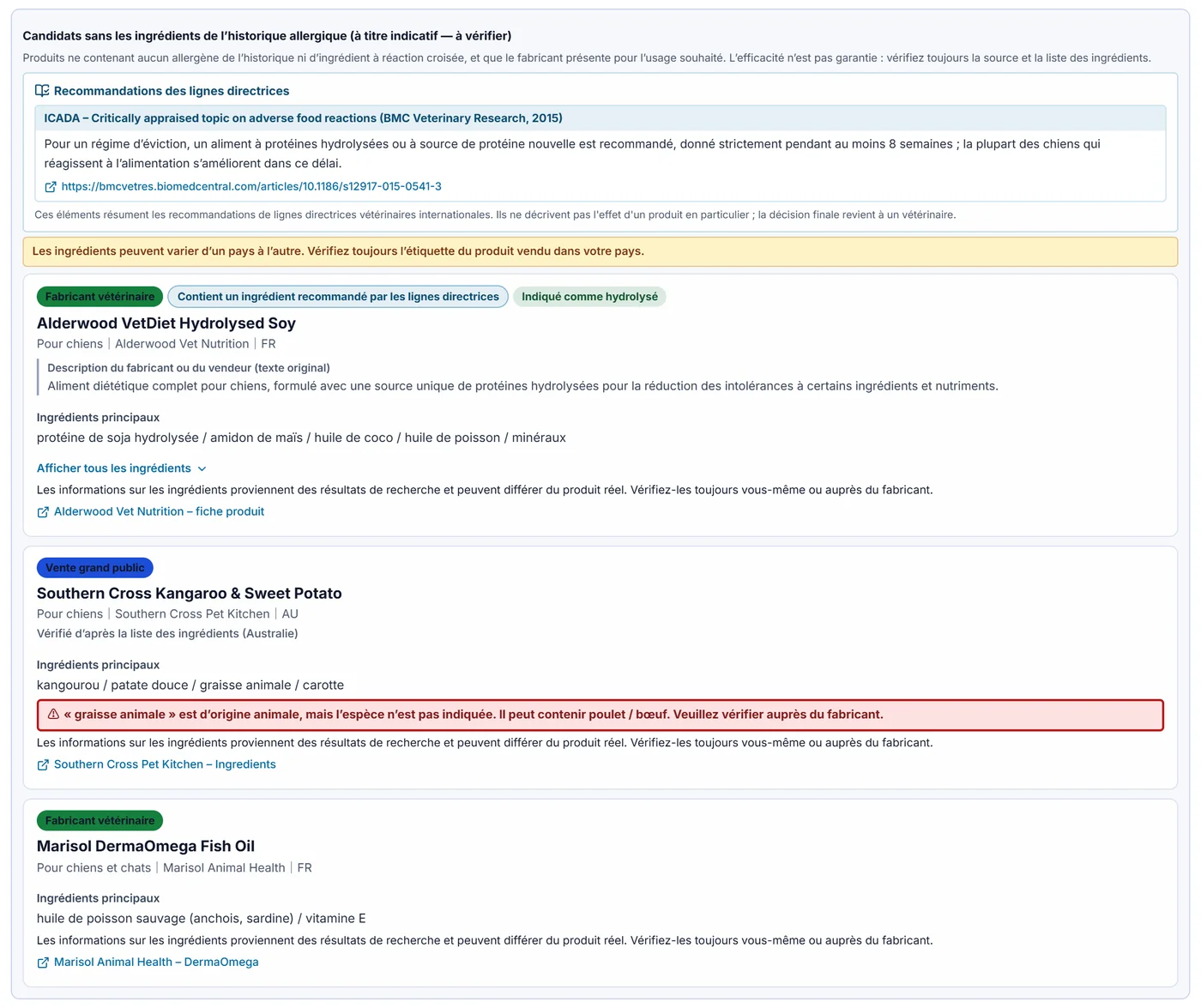
Factdock shows foods and supplements for the same purpose that do not contain the problem ingredients, as options with their sources. It searches pet foods and supplements from 37+ countries and clearly marks hydrolysed diets.
The choice is for the vet and the owner to make together. Because the options come with sources, they are also easier to explain.
STEP 4 Drug, supplement & food cross-check: is that combination OK?
You plan to prescribe something for the itching. And then there is the supplement the owner brought in.
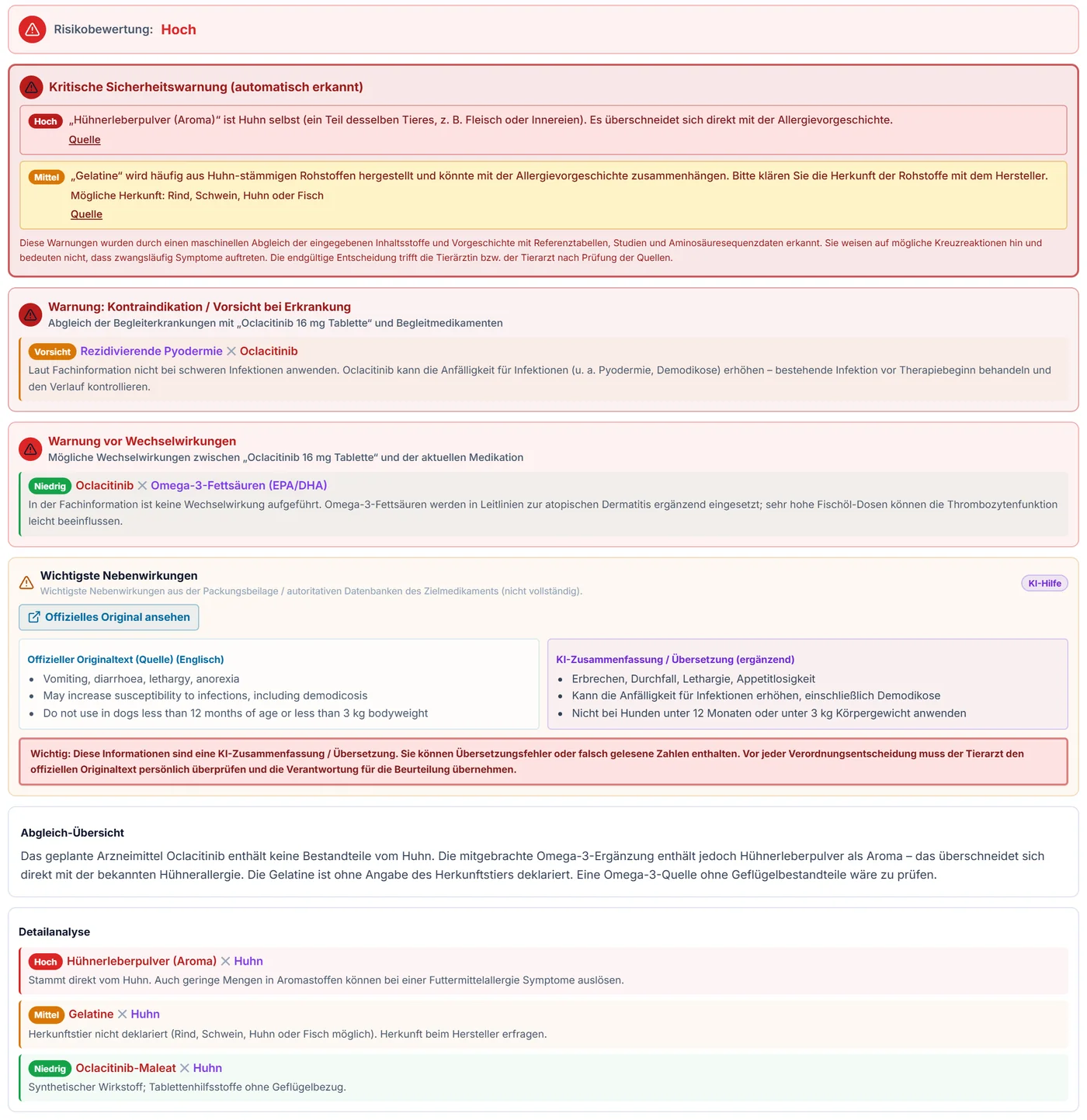
The drugs, supplements and therapeutic diets you plan to give are checked against the patient's allergy history, species and existing conditions. Overlapping ingredients or drug classes, classes with reported cross-reactions, interactions listed on the package insert, and ingredients that need care in that species are all shown with their sources.
It searches veterinary medicines from 40+ countries and pet products from 37+ countries.
One more: check your usual walking route with the Epidemic map
This dog, it turns out, goes for a walk every day along a nearby riverbank and through grassy areas.
Which diseases that pass from animals to people you need to watch for depends on where you live. In East Asia, including Japan, China and Korea, it is tick-borne SFTS (severe fever with thrombocytopenia syndrome). In many other parts of the world, rabies, leptospirosis and echinococcosis are everyday concerns.
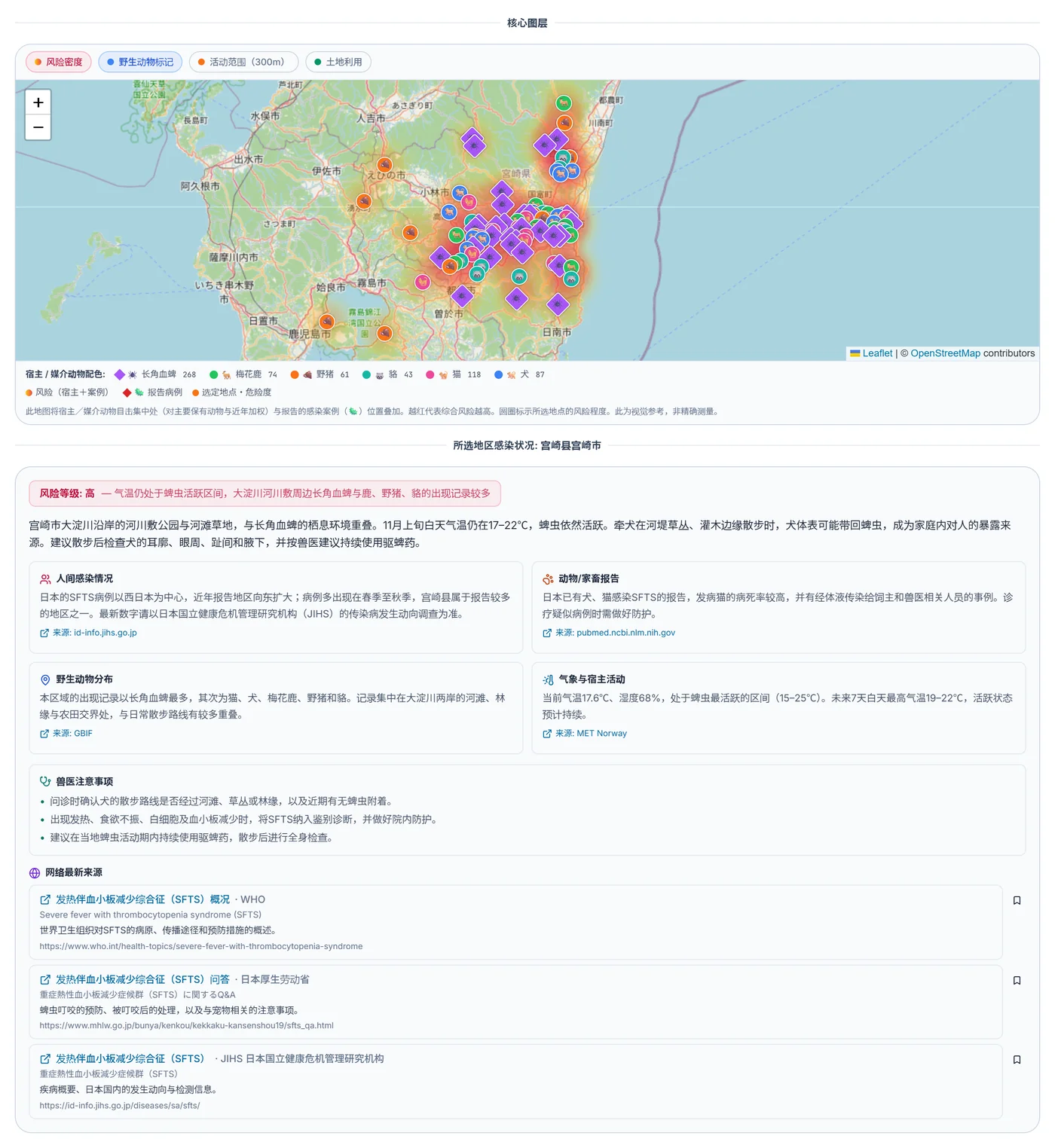
On the Epidemic map, just choose a location and a disease, and occurrence, the distribution of hosts and vectors, and weather conditions are layered on one map. Data from WHO and national public agencies is shown with its source, and the key points are explained in your own language.
With the map in front of the owner, you can give prevention advice that fits their daily walks, such as "watch out for ticks this season". And of course, you can also check a destination before a trip or a move.
One screen, one continuous flow
Looking back, this is how the case went:
- Clinical analysis — rank candidates by overlap, from symptoms and lab values
- Allergy history & detail analysis — see whether the current diet carries a risk of cross-reactivity
- Food and supplement options — find products the dog can likely eat
- Cross-check — check the combination of the planned drug and the supplement
- Epidemic map — check infections along the usual walking route
Until now, this kind of research meant going back and forth between many websites and papers, in many languages. Now you can do it on one screen, in your own language.
Who we built this for
- Vets in general practice — cut down the daily "let me just check" moments, and give that time back to the animals and owners in front of you
- Specialist and referral hospitals — for atypical cases, when you want new leads from similar reports around the world
- Veterinary students and researchers — when you want to survey one topic across literature from many countries
- Anyone who prefers to search in a language other than English — input and results, all in your own language
In closing
Factdock's veterinary tools are not meant to give answers in place of the vet. Their aim is to gather evidence scattered around the world, quickly, in your own language and with sources. The decision based on that material belongs to the vet who is caring for the animal.
We will introduce how to use each tool in detail, one at a time. For now, give it a try the next time you wonder, "How is this kind of case handled abroad?"
* The information shown is reference information based on public information found through search. It is not a diagnosis or a treatment instruction.
Frequently asked questions
Does Factdock make the diagnosis?
No. Factdock is a tool that searches papers and official data from around the world and lays out the material for your decision, with sources. Diagnosis and treatment decisions are made by the vet.
Which languages can I use?
Factdock supports 109 languages, and both the input and the results work in your own language. In Clinical analysis, on top of English-language literature, you can also search literature in up to 4 more languages, such as Japanese, Korean, Chinese, German, French, Spanish and Arabic.
Does AI guess the disease name?
In the "fact matching" mode of Clinical analysis, AI is not asked to guess a disease name. It searches the literature channel by channel using only the observed facts you entered, such as symptoms, findings and lab values, and diseases that come up across several channels are ranked higher. Each candidate shows which channels it was found in and how many sources. There is also a "hypothesis testing" mode that searches the literature from a suspected disease, and you can compare the two.
How are the food and supplement options chosen?
Options are products for the same purpose that do not contain ingredients from the allergy history or ingredients with reported cross-reactions. We search pet foods and supplements from 37+ countries and show the sources for the ingredients alongside them. The same product name can have different ingredients in different countries, so please also check the label in your country.
How much does it cost?
Plans start from $9 per month. Each tool is used per run, within the credits included in your plan. And right now, Starter and above are 50% off for the first 30 days.
Vets make the diagnosis. Find the evidence with Factdock, in your own language.
From symptoms to allergies, food, drugs and infectious diseases. Gather evidence from around the world, with sources, on one screen.