
Introduction: PubMed comes with a language barrier
Most medical and veterinary papers can be found on PubMed. But building search terms in a foreign language, reading many abstracts in a foreign language, and checking case counts and study types one by one is hard between patients.
- You are not sure how to combine search terms
- Searching "treatment outcomes" and "complications" separately doubles the work
- Even after reading an abstract, it is not clear how many cases the study had or what kind of study it was
- When nothing turns up, you cannot tell whether no papers exist or the search was wrong
Medical & veterinary literature is a tool built for medical and veterinary questions that cuts down this work.

What is the Medical & veterinary literature tool?
Choose the disease or treatment you want to look into and the aspects you want to know about. The tool builds search terms for each aspect and searches the papers listed in PubMed. You just answer a few questions.
- Choose the subject — human or animal. For animals, choose from dog, cat, rabbit, cattle, pig, horse, sheep, goat, ferret and bird
- Enter the disease or treatment — type it in your own language, or say it by voice
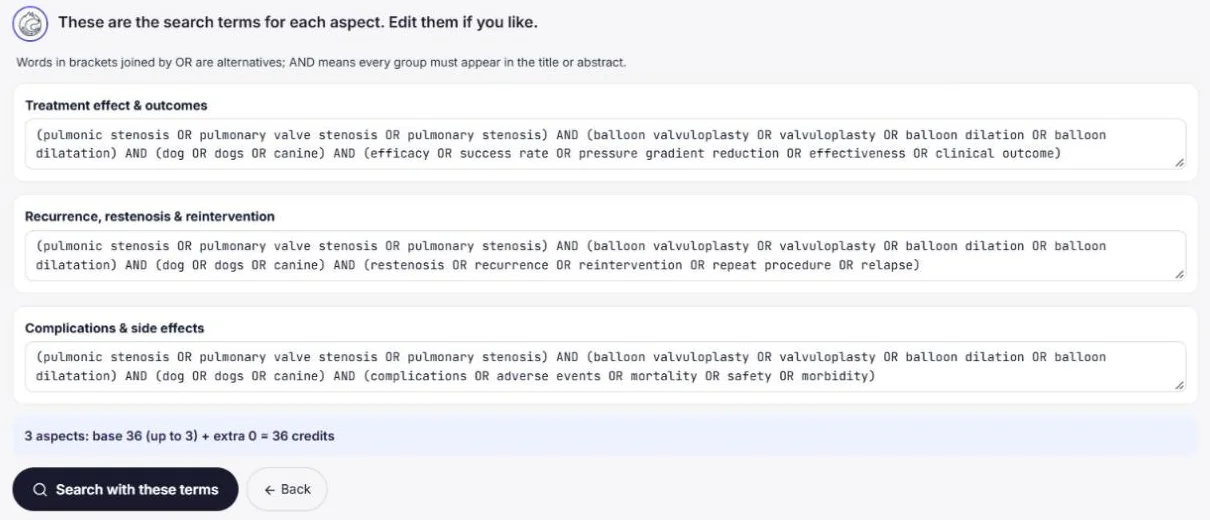
- Choose the aspects — 16 aspects, such as treatment efficacy and outcomes, prognosis and survival, recurrence, complications and adverse effects, diagnosis, drugs and dosage, surgery and procedures, comparison of treatments, and guidelines. You can also add your own
- Check the search terms — the search terms for each aspect appear on screen. You can edit them right there
What you can check in the results
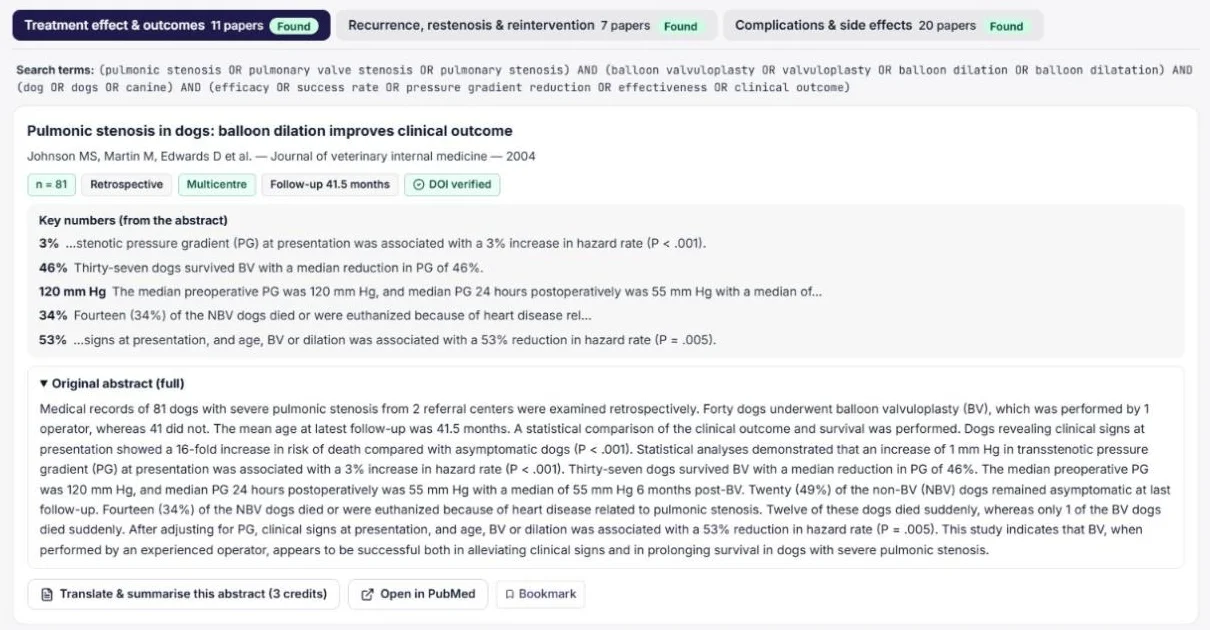
Results are split into a tab for each aspect, with up to 20 papers per aspect. Each paper gets tags that help you judge it.
Case count, follow-up and study design
From the abstract, the tool reads how many patients (or animals) were studied and how many months they were followed up. It also tags the study design: meta-analysis, systematic review, randomized, prospective, retrospective, multicenter, cohort, case series, case report or guideline. You can choose what to read before opening a single abstract.
Main numbers, with percentages recalculated
The tool pulls out the main numbers stated in the abstract. For a figure such as "38 of 45 cases (84%)", it recalculates the percentage from the counts and checks that it matches the stated value. If it does not match, the tool says so.
DOI check
The tool checks each paper's DOI and confirms that the title matches. Tags such as "DOI verified" or "Title does not match" let you check before you cite.
Read in your own language
For the top papers, a translation of the title and a short summary appear in your own language. A translation and summary of the full abstract can be requested one paper at a time with a button. The full original abstract is shown alongside. To read the full text, open it in Deep Reader or on PubMed.
Aspects with no papers go into a "Not found" tab, which also shows the search terms used. You can decide on the spot whether there are simply no papers or whether the search should change.
When there are few papers on your animal
In veterinary medicine, there may still be few papers on the animal you are looking into. In that case, the tool also shows papers on another species as reference, in a separate list. For example, for a treatment with few cat papers, you can refer to papers on dogs or humans. These are only for reference and are kept apart from papers on the species you searched.
The tool also shows national academic sites in your language in a separate section.
What we keep in mind
- The professional decides — this tool finds and checks papers. Diagnosis and treatment plans are decided by the doctor or veterinarian caring for the patient or animal
- Numbers come from the abstract, with the source — the main numbers shown are only those stated in that paper's abstract
- When nothing is found, we show the terms used — instead of stopping at "0 results", we show which terms were searched
- A tool for medical and veterinary questions — for other fields such as economics, engineering or law, please use academic search
What you see is reference information gathered from published papers. It is not a diagnosis or a treatment instruction.
Who this is for
- Clinical doctors and veterinarians — gather outcomes and complications of surgery or treatment, aspect by aspect
- Pharmacists — find papers on drugs, dosage and adverse effects
- Anyone preparing research or a conference talk — pick earlier studies using the study design tags
- Anyone who wants to research in their native language — read papers in a foreign language in your own language
To find papers outside medicine, see how to search academic databases. To read the full text of papers you found, see how to read papers in a foreign language.
Pricing
Factdock is available from $3. Each search with the Medical & veterinary literature tool uses credits from your current plan. Up to 3 aspects are included in the base price, and each extra aspect adds a little. The price is shown on screen before you search.
Conclusion
"Outcomes?" "Recurrence?" "Complications?" Simply splitting a clinical question into aspects makes the papers worth reading easier to find.
Start by trying it with the disease or treatment of a case you are thinking about now.
What it is
Academic Papers
Searches more than 15 academic databases at once for papers in fields other than medicine, such as economics, engineering, law and the environment. Builds one list without duplicates that you can read in your own language. Medical and veterinary papers can be searched in Medical & veterinary literature.
Medical & Drug Data
Searches the official drug databases of regulators in more than 20 countries and regions, in your own language. Shows drug labels for human and veterinary medicines and counts of reported side effects, with sources. Clinical papers can be searched in Medical & veterinary literature.
Factdock in 2 minutes 30 seconds
The video is in English. You can choose subtitles in your language from the player settings.
Frequently asked questions
Which database does it search?
It searches the papers listed in PubMed, aspect by aspect. It also shows national academic sites in your language in a separate section.
Can it search papers on animals?
Yes. You can choose from dog, cat, rabbit, cattle, pig, horse, sheep, goat, ferret and bird. When there are few papers on the animal you searched, papers on another species are shown separately as reference.
Can I edit the search terms myself?
Yes. The search terms for each aspect appear on screen, so you can edit them before searching.
Can I use it in English?
Yes. You can ask your question and receive abstract translations and summaries in English. Besides English, it works the same way in 109 languages, including your native language.
Does it cost anything?
Factdock is available from $3. Each search with the Medical & veterinary literature tool uses credits from your current plan. The price is shown on screen before you search.
Our own patent-pending search engine
Clinical questions, aspect by aspect.
Just choose a disease or treatment and the aspects. Get PubMed papers with case counts, study design and DOI checks. Read the abstracts in your own language too. Available from $3.