
Introduction: "Which food can I recommend for this patient?"
After a consultation, owners often ask questions like these.
- "Is the current food OK? What else can I feed?"
- "If chicken is a problem, can he eat turkey or duck?"
- "Is this supplement safe even with her allergy?"
- "I bought this food abroad and the ingredient list is in a foreign language."
To answer, you need to check every ingredient in the food and also think about cross-reactivity from similar proteins. There are many products, and labels use many different terms. Checking them one by one takes a lot of time.

Three things to check before recommending a food
1. Check every ingredient
Look beyond the main ingredients. Check fats and oils, extracts, flavourings and gelatin as well. Be careful with ingredients whose source is not clearly stated, such as "animal fat" or "meat by-products".
2. Consider cross-reactivity
Patients may react to ingredients that contain proteins similar to the allergen, for example meat from closely related animals. Protein sequence similarity is a useful guide to which combinations need care.
3. Match the purpose and the species
Avoiding the allergen is not enough. The food must also suit any existing conditions or goals (kidney, joint, skin and so on), and be made for the right species, dog or cat.
A product with the same name can have different ingredients depending on the country or factory. Always check the ingredients of the version sold in your country before recommending it.
Check ingredients and cross-reactivity together with Factdock's veterinary tools
Factdock's Veterinary Intelligence includes "Allergy history & detail analysis" and "Drug, supplement & food cross-check". They compare the allergy history with what the animal eats now and what you plan to recommend, at the level of ingredients and proteins.
These tools support the veterinarian's judgement. They do not make a diagnosis or a prescription. The ingredients shown are compiled from searches and may differ from the actual product. Always check the product label or the manufacturer's information before recommending.
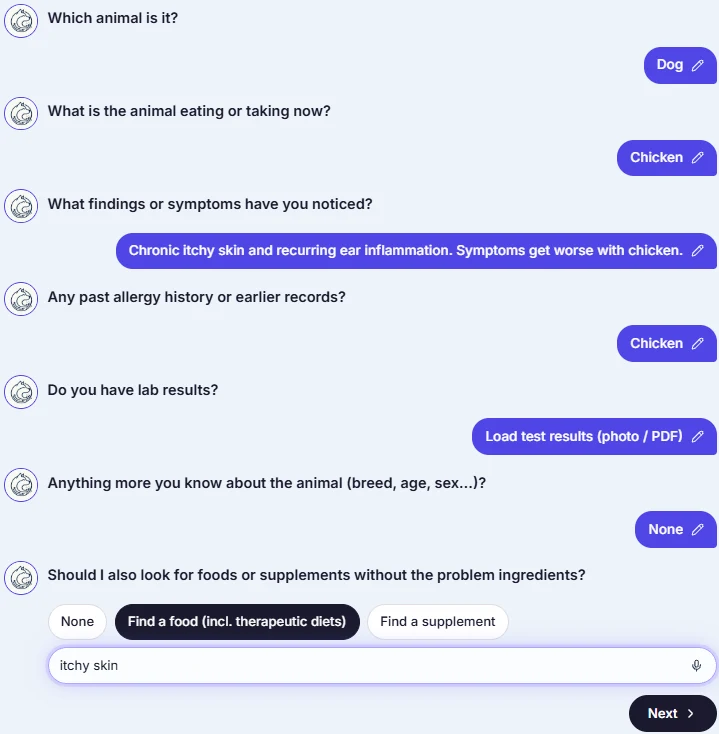
1. Enter the allergy history and the current diet
Enter the species, known allergies, and the current food, treats and supplements. You can search for products by name and select them.
2. Compare ingredients and cross-reactivity
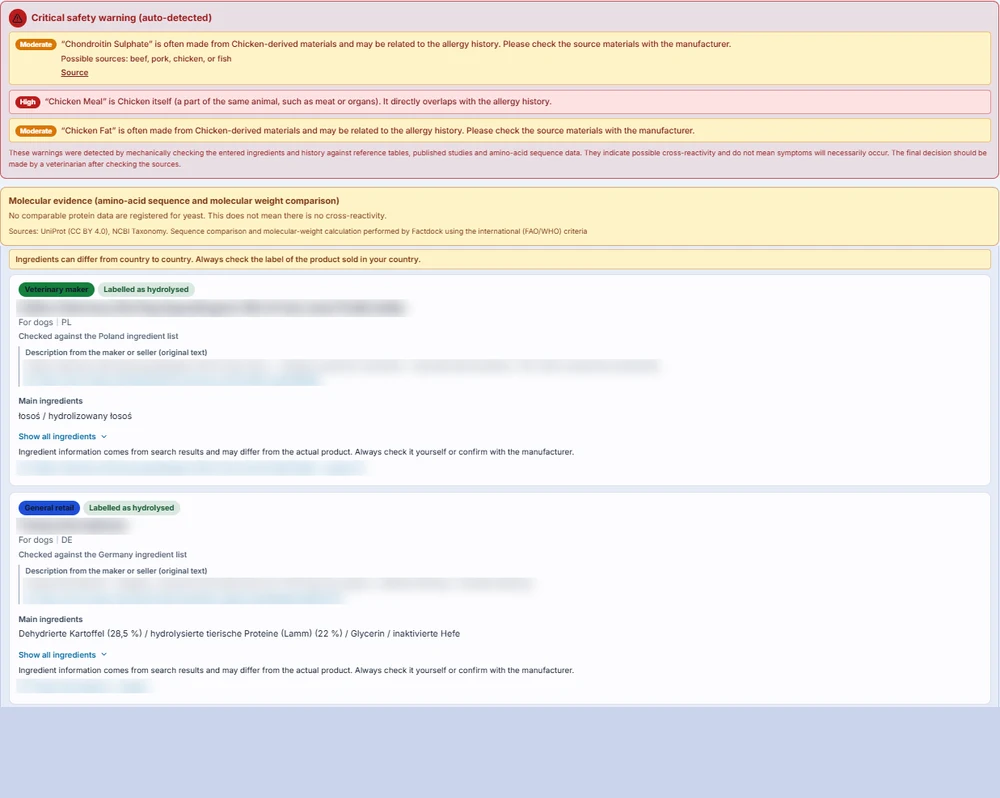
The tool checks each product's ingredients, for example from the manufacturer's official information. It finds ingredients that match the allergen and ingredients with similar proteins. Protein similarity is checked against published sequence data, and confirmed and inferred cross-reactivity are shown separately. For ingredients of unclear origin, a likely source is flagged as a caution, with references.
3. See suitable food and supplement options
From products with the same purpose and for the same species, the tool lists options that do not contain the problem ingredients or ingredients of concern for cross-reactivity. Hydrolysed diets are marked, which helps when choosing.
For an overview of the veterinary tools, see our introduction to the veterinary tools. To look up veterinary medicines from other countries, see how to search drug databases.
Who this is for
- Vets in general practice — when you need to find suitable foods or supplements quickly for a patient with food allergy
- Vets working in dermatology and allergy — when you want to narrow down elimination diet options by ingredients and cross-reactivity
- Veterinary nurses — when you want to check ingredients before talking to the owner
- Anyone who wants to work in their own language — foreign-language ingredient labels, read in English
Pricing
Available from $3. Feel free to give it a try. You will find full details on our pricing page.
Conclusion
Choosing a food for a patient with food allergy means checking ingredients and cross-reactivity one by one. It takes patience. When you can narrow down the options with clear evidence, you can explain your choice to the owner with confidence.
Next time you wonder "Which food can I recommend for this patient?", start by checking the options from the allergy history.
Note: The information shown is reference information compiled from public sources. It is not a diagnosis or a prescription. Before recommending any food or supplement, always check the ingredients on the product label or with the manufacturer, and use your own professional judgement.
What it is
Veterinary Intelligence
Matches case information and images against primary sources worldwide and organises candidates by how the retrieved literature overlaps. From allergen cross-checking to the epidemic map, four advanced specialist tools work together on a single screen.
Medical & Drug Data
Searches the official drug databases of regulators in more than 20 countries and regions, in your own language. Shows drug labels for human and veterinary medicines and counts of reported side effects, with sources. Clinical papers can be searched in Medical & veterinary literature.
Factdock in 2 minutes 30 seconds
The video is in English. You can choose subtitles in your language from the player settings.
Frequently asked questions
Can pet owners use it?
The veterinary tools are designed to support the judgement of veterinarians. They are meant to be used by vets, as part of a consultation.
How do you check cross-reactivity?
We use published protein sequence data to find ingredients with proteins similar to the allergen. Confirmed and inferred cross-reactivity are shown separately.
Where does the ingredient information come from?
We give priority to the manufacturer's official information. When it is not available, we use the ingredient list on retail sites, with the source shown. It may differ from the actual product, so always check the product label before recommending.
Can I use it in English?
Yes. You can enter information and see results in English. The tools work the same way in 109 languages.
How much does it cost?
It is available from $3. For full details, please see our pricing page.
Our own patent-pending search engine
Choose foods for allergic patients by ingredients and cross-reactivity.
Just enter the allergy history and the current diet. Check ingredients and cross-reactivity, and see suitable food and supplement options in English.