
First: “What is this drug called here?”
In medical practice, checking a drug across borders comes up more often than you might expect.
- “A patient came in with a drug prescribed abroad. What is the active ingredient?”
- “A patient brought in a medicine they imported for personal use. What is the active ingredient? Is it approved in our country?”
- “We are considering importing a medicine that is not approved here, for treatment. How is it approved abroad?”
- “This brand name is probably sold under a different name in our country.”
- “A veterinary medicine approved abroad. What is in it, and which animals is it for?”
- “How many adverse events have been reported for this ingredient?”
The answers start with the drug databases published by each country's regulatory authority. But most of them are written in that country's language, and the way to search them differs from country to country.

Drug database basics: what to know first
1. Drug names differ from country to country
Even with the same active ingredient, the brand name differs by country and by manufacturer. When you check a drug across borders, the basic rule is to confirm it by its active ingredient (generic name).
2. Approval information and package inserts are published by each country's regulator
In many countries, the regulatory authority publishes information on approved medicines and their package inserts (product information) as a database. Examples include the FDA in the US, the European Medicines Agency (EMA) in the EU, and the Ministry of Health, Labour and Welfare in Japan.
3. Veterinary medicines are often in a separate database
In many countries, veterinary medicines are managed by a different agency, in a different database from human medicines. Examples are the National Veterinary Assay Laboratory in Japan and the FDA's Green Book in the US.
4. Adverse event reports are “counts”, not “assessments”
The US FDA and others compile and publish the adverse event reports they receive. However, the number of reports does not directly show whether a drug is safe or dangerous. Interpreting it requires professional judgement.
In every case, the first place to turn is the official information published by each country's regulatory authority. But because the language and the way to search differ from country to country, just checking takes a lot of time.
The hard part: finding and reading “other countries' databases”
- The language barrier — databases and package inserts are written in that country's language
- Too many places to look — human and veterinary medicines, country by country, every source is separate
- The name barrier — searching by brand name often finds nothing, and converting it to the active ingredient takes extra work
Going back and forth between several countries' websites in the middle of a busy clinic or dispensing shift is hard work.
Search in your own language with Factdock's Medical & Drug Data
Factdock's Medical & Drug Data is a search tool that searches in your own language the drug databases published by each country's regulatory authority, and shows the results in your own language.
This tool is a search tool for medical professionals. It only searches and displays published data. It does not judge the efficacy or safety of a drug, and it does not recommend any diagnosis, prescription or treatment. All judgements must be made by the professionals themselves.
Note: the screenshots in this post are shown in German and Spanish. It works the same way in every language.
1. Choose what to look up, and type in your own language
Choose one of four: human medicines, veterinary medicines, adverse event report counts or medical literature, then type the drug name or active ingredient in your own language. You can start with either a brand name or an active ingredient.
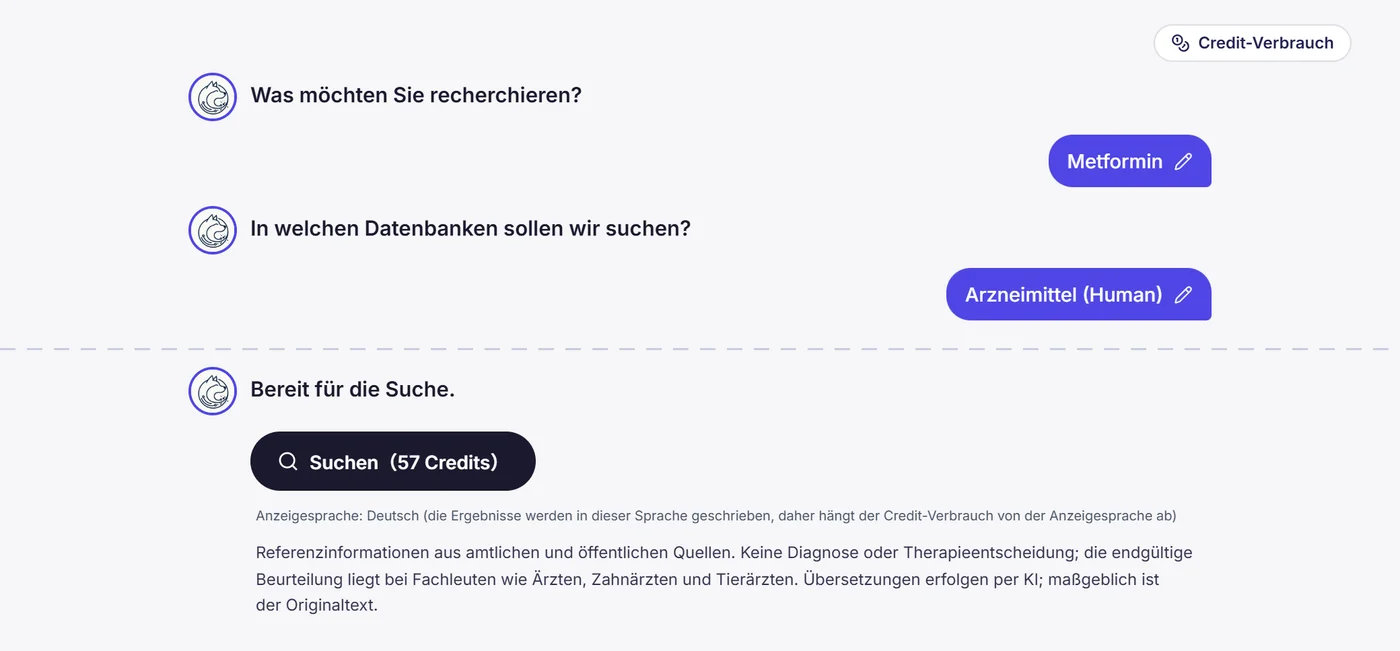
2. Search the official databases of each country
For human medicines, we search the databases of regulators in Japan, the US, the EU, Canada, Taiwan, Singapore, Spain, France, Italy, Switzerland, Hong Kong and more. For veterinary medicines, we search databases in more than 25 countries and regions. Adverse event report counts are searched in the US FDA's public data, and medical literature in PubMed.
3. Results in your own language — and you always know which country and which database they come from
The information found is translated into your language, and we always show which country and which database it comes from. You can also open the original official page as it is, and check the original text.
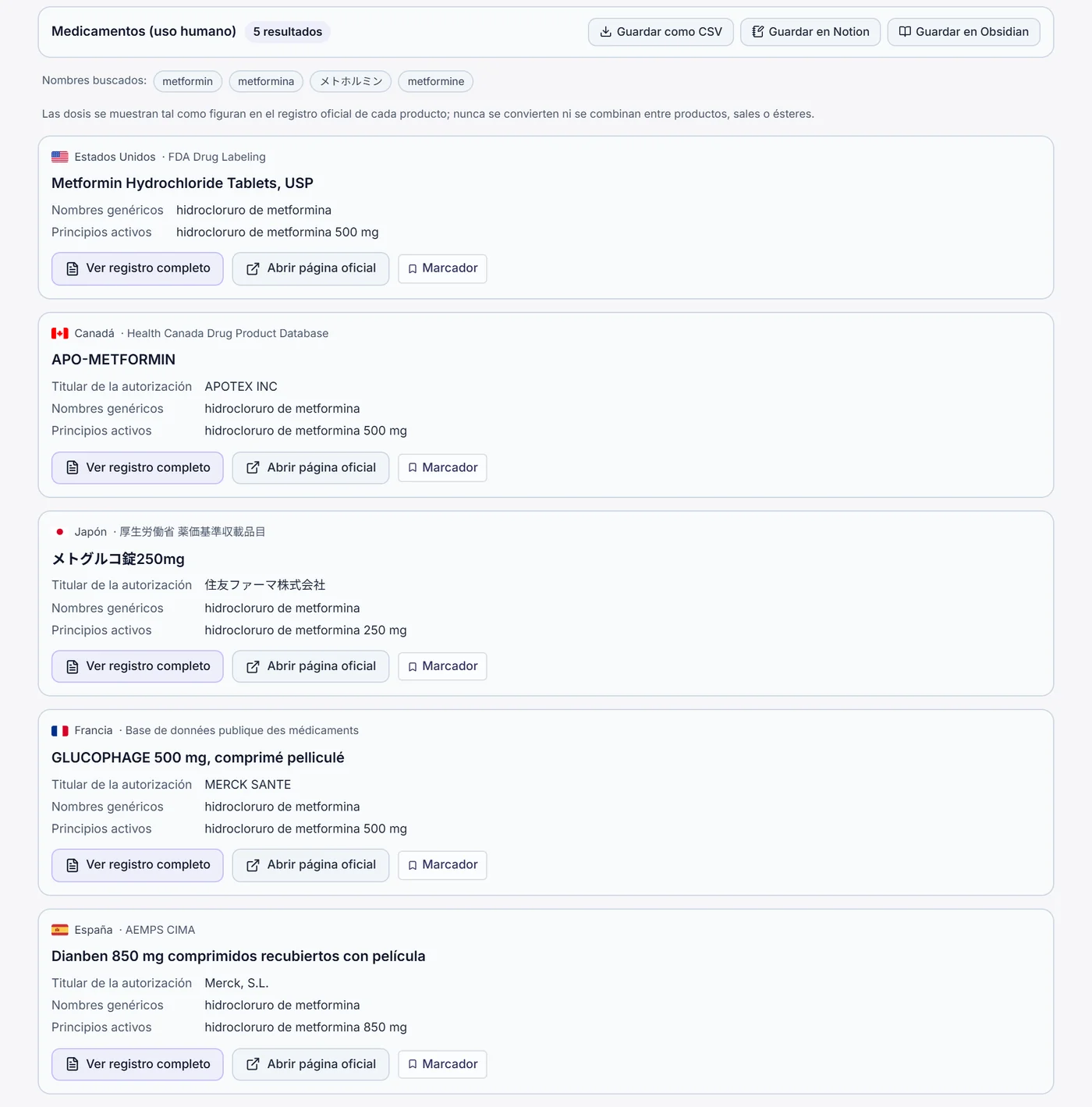
Translations are there to help you grasp the content. Always check dosage and administration, warnings and other details in the package insert against the original text and your own country's official information.
Who we made this for
- Doctors and dentists — when you want to check the active ingredient of a drug prescribed abroad, or the approval status in each country of a medicine you are considering importing
- Pharmacists — when you want to check, starting from the active ingredient, a foreign drug a patient brings in or a medicine they imported for personal use
- Veterinarians — when you want to find out where and how a foreign veterinary medicine is approved
- People in pharma, research and regulatory affairs — when you want to compare approval information and adverse event report counts across countries using official data
- People who want to search in languages other than English — input and results, in your own words
If you want to build it into your own system: the Medical DB API
For hospital, pharmacy or veterinary clinic systems, or for universities and research institutes, we also offer the Medical DB API for organizations. It lets your system search the medicine information published by each country's regulators, adverse event report counts and medical literature over REST API or MCP. Every record comes with its official source URL. For details, see the Medical DB API page.
Pricing
Plans start from $9 per month. Feel free to give it a try. You can find full details on our pricing page.
Final thoughts
Checking drugs across borders will only become more common. When it does, what you can rely on is the official information published by each country's regulators.
If you ever wonder, “How is this drug handled in that country?”, start by looking it up in your own language.
Note: The information shown is the result of searching data published by each country's regulatory authorities and other bodies. Judgements on a drug's efficacy or safety, and on diagnosis, prescription and treatment, must always be made by the professionals themselves.
Factdock in 2 minutes 30 seconds
The video is in English. You can choose subtitles in your language from the player settings.
Frequently asked questions
Who is this tool for?
It is a search tool for medical professionals such as doctors, dentists, veterinarians and pharmacists. It searches and displays published data, and it is not a substitute for diagnostic or prescribing decisions.
Does it tell me whether a drug is effective or safe?
No. Factdock only searches and displays drug data published by each country's regulatory authorities and other bodies. It does not judge efficacy or safety. Those judgements are for professionals to make themselves.
Which countries' databases can I search?
For human medicines, we search the databases of regulators in Japan, the US, the EU, Canada, Taiwan, Singapore, Spain, France, Italy, Switzerland, Hong Kong and more. For veterinary medicines, we search databases in more than 25 countries and regions. Adverse event report counts are searched in the US FDA's public data, and medical literature in PubMed.
Can I use it in my own language?
Yes. Both your input and the results are shown in your own language. It works the same way in 109 languages, including your native language.
How much does it cost?
Plans start from $9 per month, so it is easy to get started. For full details, please see our pricing page.
Our own patent-pending search engine
Each country's drug databases, in your own words.
Just choose what you want to look up and enter the drug name. Check official data from each country's regulators in your own language, with sources.