
Introduction: we are living with an inequality of information
When you need to look something up, you probably reach for Google or another search engine.
But there is a real problem with what comes back. The first and second pages are filled with "excellent" sites built for SEO — search engine optimisation — and with advertising.
The primary sources you actually wanted are often sitting on page ten, or deeper still. These "genuinely valuable pages, buried out of sight" are frequently not optimised for search at all, so they never appear where people click.
And in recent years the rise of AI has made the situation worse.
The quiet loss of information in the age of AI

"Just ask ChatGPT, Gemini or Claude and you have your answer in one shot" — that is where we are now. But there is something here worth worrying about.
When an AI summarises, the pages it draws on are, in the end, the same ones: sites that rank because they were optimised for search, and sites written to be picked up by AI summaries.
Because AI summarises those top-ranking, optimised pages, the genuinely important material that used to sit on page ten simply is not included — and readers finish without ever reaching what they were actually looking for.
As a result, traffic to the specialist blogs and useful pages that anyone could once reach has collapsed, and the valuable information sleeping on the internet is quietly being lost. According to Similarweb, organic search traffic — search that is not advertising — to outlets such as HuffPost and The Washington Post has halved in three years.
So where has the genuinely valuable information gone?
The language gap: is everyone outside the English-speaking world an information refugee?
There is a second problem, and it is easy to overlook. It is language.
According to W3Techs, about 49.5% of websites on the internet are written in English, while people who speak English as a first language are said to be only about 5% of the world's population.
For the remaining 95%, reaching exactly the right material among the internet's vast holdings — in a language that is not their own — is extremely difficult.
Long before they can get to "the valuable page on page ten", the language barrier has already turned them away.
Our answer: Factdock, a primary-source search platform
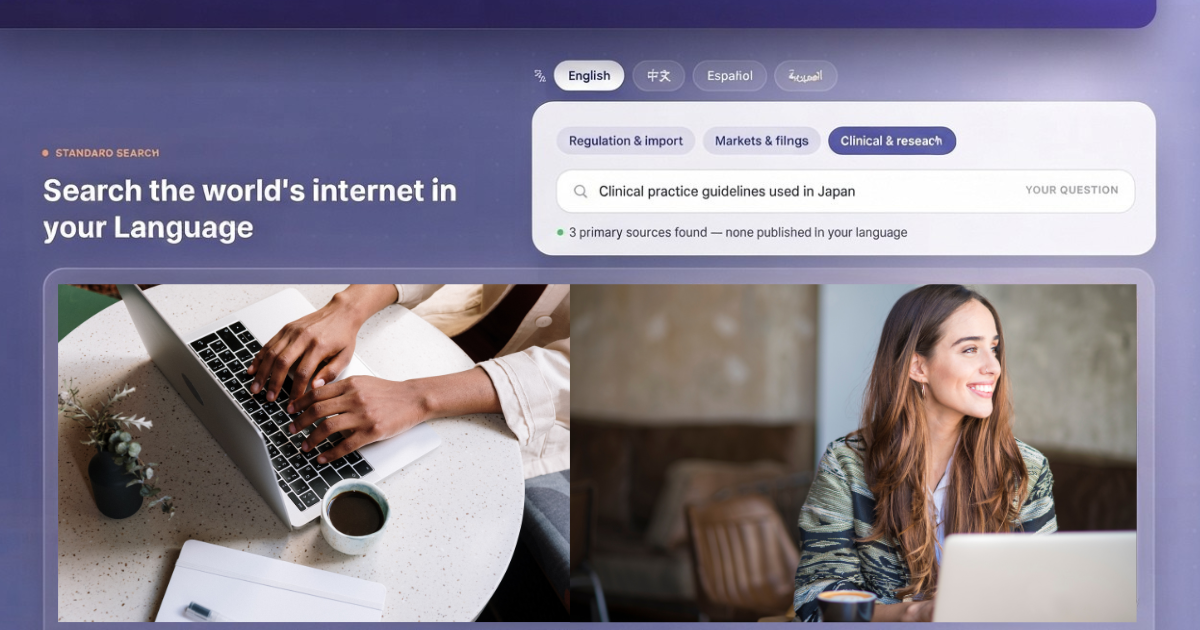
That is why we built Factdock, an AI search platform for primary-source research.
Factdock pursues the democratisation of information through three approaches.
1. Search in your own language, reach the world's primary sources
You simply type what you want to know, in the language you already use, exactly as it occurs to you. Factdock converts your words into the phrasing people actually search with locally, and searches in that language. So even without English, you can dig into the world's databases in your own words.
2. Bringing what sat on "page ten" to the front
Rather than the rules of ordinary search engines or AI search, Factdock applies its own — putting the primary source first: government notices, academic papers, corporate registry records, patent gazettes, the origin itself, rather than a well-optimised page about them.
Material that once lay buried deep on page ten is lifted to the very front.
3. From searching to reading, all in your own language
Factdock works in 109 languages. Result titles and summaries appear in your language, and the pages behind them are translated by Factdock's own tools as you open them. From searching to understanding, it happens in one continuous motion.
Specialist fields, made reachable
Most specialist databases assume you will search them in English.
Factdock carries 12 search engines, each built for its own field: patents (including novelty searches), company information, infrastructure development, veterinary work and more. All of them work in your own language, which lowers the barrier for researchers and founders dramatically.
- Patents and technology — prior-art searches, checking novelty
- Academic papers — searching peer-reviewed literature across sources
- Companies and risk — confirming an overseas company exists, vetting counterparties
- Legal and contracts / Finance and investment / Real estate investment
- Government and infrastructure / Trade and compliance
- Sales channel search / OEM and manufacturing sourcing
- Veterinary and animal health / Cross-web research
Our mission: equal access to information
The internet holds an enormous amount of information, and yet language and search algorithms mean not everyone can see it equally. That is a profound inequality.
- Because of the language barrier, there may be places where a treatable illness goes untreated.
- There may be people with an excellent product or idea who are missing the business opportunity because of language.
- There may be people making decisions without the information they ought to have, simply because it is written in another language.
In an age when AI summarises and hands you an "answer", Factdock deliberately offers the other thing: direct access to the primary source.
A world where you can reach the information you need equally, wherever you live and whatever language you speak. That is the future we want to build with Factdock.
Frequently asked questions
Does it replace Google?
No. For everyday questions Google is faster, and Factdock is not trying to take its place. We suggest using it for information abroad that you cannot search directly in your own language, for material buried deep out of sight, and for the research you have to be able to stand behind at work — overseas regulations, patent prior-art searches, credit checks on foreign companies, academic papers.
How is it different from an AI-generated answer?
An AI gives you a summary; Factdock gives you the source itself — the primary material. A summary is fast, but where it came from becomes blurred. Factdock also reaches information that AI summaries never include.
Can I use it entirely in my own language?
Yes. Entering your question, reading the results and working through the documents all happen in the language you are used to. 109 languages are supported.
Can I search without specialist knowledge?
Yes. Factdock handles the conversion into local terminology and the local language, so you do not need to know the exact term.
Reach the world's primary sources, in your own language.
Overseas regulations, patents, company information, academic papers. Everything you used to have to search for in English, now in the words you already use.