
First: "What kind of company is this?"
When you do business abroad, situations like these come up all the time.
- "We're dealing with this overseas company for the first time. Before signing, we want to make sure it really exists."
- "A company has contacted us wanting to become our distributor. We'd like to know who they are."
- "We want to know who our supplier's parent company is."
- "We're worried there may be local reports of lawsuits or quality problems."
The foundations for checks like these are each country's commercial registers and disclosure systems, and news and records written in the local language. The trouble is that both the systems and the languages are completely different from country to country.

The basics of checking an overseas company
1. A company's "birth certificate" is in that country's registry
Most countries have a commercial register that records a company's name, address, date of incorporation, directors and so on. It is the best place to start when you want to confirm that a company really exists.
2. More companies share similar names than you might think
Parent companies and subsidiaries, or unrelated companies with similar names. If you search without comparing addresses and directors, you may end up researching a different company. The first step is to pin down exactly which company you mean.
3. Check sanctions lists before you do business
Governments and international organisations publish sanctions lists of parties you must not do business with. Before a deal, it is worth checking that neither the company nor its officers appear on them.
4. Important information is often only in the local language
Lawsuits, administrative penalties, product recalls, a company's reputation with its customers. This kind of information is often reported only in that country's language, not in English.
In every case, the first place to look is that country's public records and information in the local language. But because systems and languages differ from country to country, researching it yourself is hard work.
The hard part: checking "the way that country does it"
- The system barrier — how registration and disclosure work, and where to look, differs by country
- The language barrier — registries and news are written in that country's language
- The name barrier — many companies have similar names, so it is easy to research the wrong one
Check it in your own language with Factdock's Corporate Intelligence
Factdock's Corporate Intelligence is a search tool: just enter a company name and a country, and it searches in both the local language and English, starting from that country's public registries and disclosures, then shows the results in your native language.
This tool searches and organises publicly available information. It does not give a credit rating, and it does not decide whether you should do business with a company. The final decision is yours, together with professionals where needed.
* The screenshots in this article are samples using a fictitious company. They are not related to any real company.
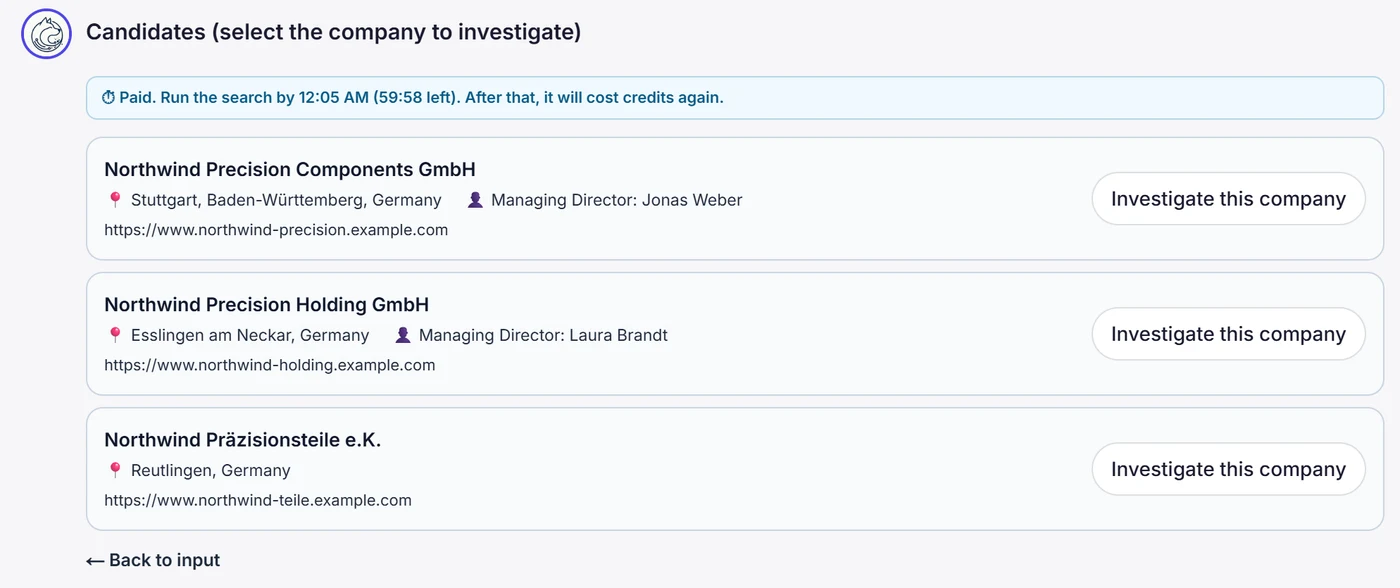
1. Enter the company name and country, and first confirm "which company"
Enter the company name and country (or the official website URL), and we first show a list of candidate companies. You compare addresses and directors, choose the company you want, and then move on to the detailed check. This reduces the risk of researching a different company with a similar name.
2. Registries and disclosures in about 50 countries, in the local language
Starting from the commercial registers and disclosure portals of about 50 countries, we search in that country's language and in English. We also search public information about lawsuits, administrative penalties and sanctions.
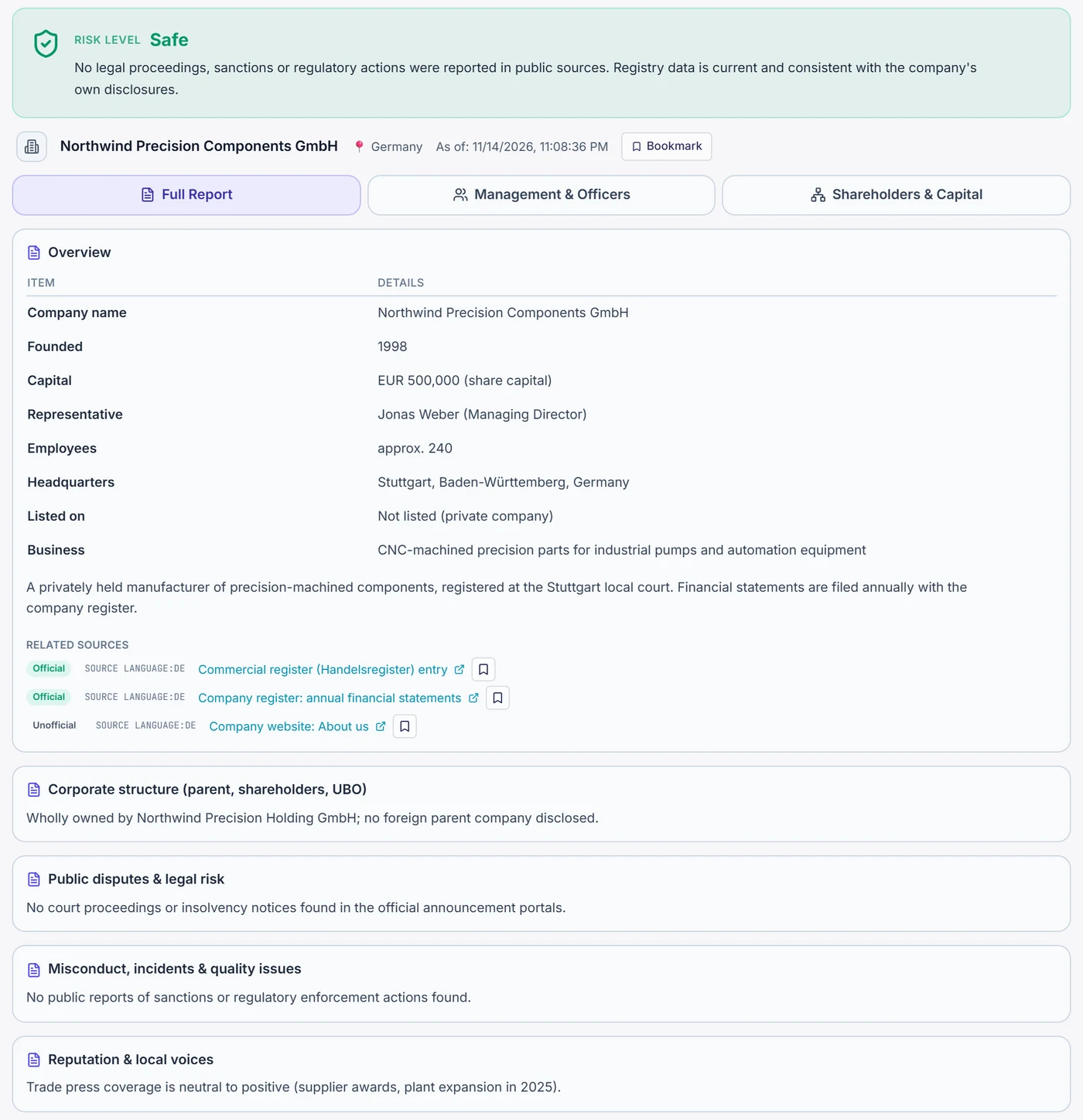
3. Organised from 5 viewpoints and shown in 3 levels
Results are organised from 5 viewpoints — Basic profile, Corporate structure, Official and legal trouble, Misconduct and quality, and Local reputation — and shown in 3 levels: "Safe", "Caution" and "High". Anything that could not be confirmed from public information is left blank rather than filled in by guesswork. Every piece of information comes with a source link.
4. Go one step deeper, to management and shareholders, if you need to
You can also look into officers' backgrounds and the shareholder structure. You can check who actually runs the company, with sources.
Who we made this for
- People at companies starting to trade overseas — when you want to confirm, before signing, that the other party exists and isn't in trouble
- People in purchasing and procurement — when you want to check a new supplier or its parent company
- People in sales and distributor development — when you want to research potential distributors or customers in advance
- People in investment and M&A — when you want to confirm a target's capital structure and management through public records
- People who want to research in a language other than English — input and results in your own language
Pricing
You can start from $3. Feel free to give it a try. You can find full pricing details on our pricing page.
In closing
Doing business with an overseas company is a big opportunity. That is exactly why it is reassuring to check the other party first, through that country's public records.
If you find yourself wondering "What kind of company is this?", start by researching it in your native language.
* The information shown is the result of searching and organising public registries and publicly available information. Always make the decision on whether to do business yourself, together with professionals where needed.
What it is
Factdock in 2 minutes 30 seconds
The video is in English. You can choose subtitles in your language from the player settings.
Frequently asked questions
Which countries' companies can I check?
You can search starting from the commercial registers and disclosure portals of about 50 countries. For other countries, we still search publicly available information in that country's language and in English.
Will it tell me whether I should do business with the company?
No. Factdock only searches and organises publicly available information and shows it with its sources. We do not give credit ratings or decide whether a deal should go ahead. The decision is yours, together with professionals where needed.
Could it confuse the company with one that has a similar name?
We first show a list of candidate companies. You compare addresses and directors, choose the company to check, and only then move on to the detailed check. This reduces the risk of researching a different company with a similar name.
Can I use it in my own language?
Yes. Input and results are shown in your language. Besides English, you can use it the same way in 109 languages, including your own native language.
How much does it cost?
You can start from just $3. For full pricing details, please see our pricing page.
Our own patent-pending search engine
Check overseas partners through that country's records. In your own language.
Just enter a company name and a country. Check that country's public registries and local-language information, with sources, in your native language.